The pair that taught us this lesson looked perfect in the listing. Good wash, good price, seller with a clean feedback history. It wasn't until the jeans were on our own table, under a bright lamp, that something started to itch — nothing you could name at first, just a sense that the details weren't sitting where the eye expected them to sit.
That's how counterfeits usually announce themselves. Not with one glaring error, but with a handful of small ones that only add up when you're looking closely. No single check below is proof on its own. Run all four and you'll almost always know.
The tab is stitched, not stuck on
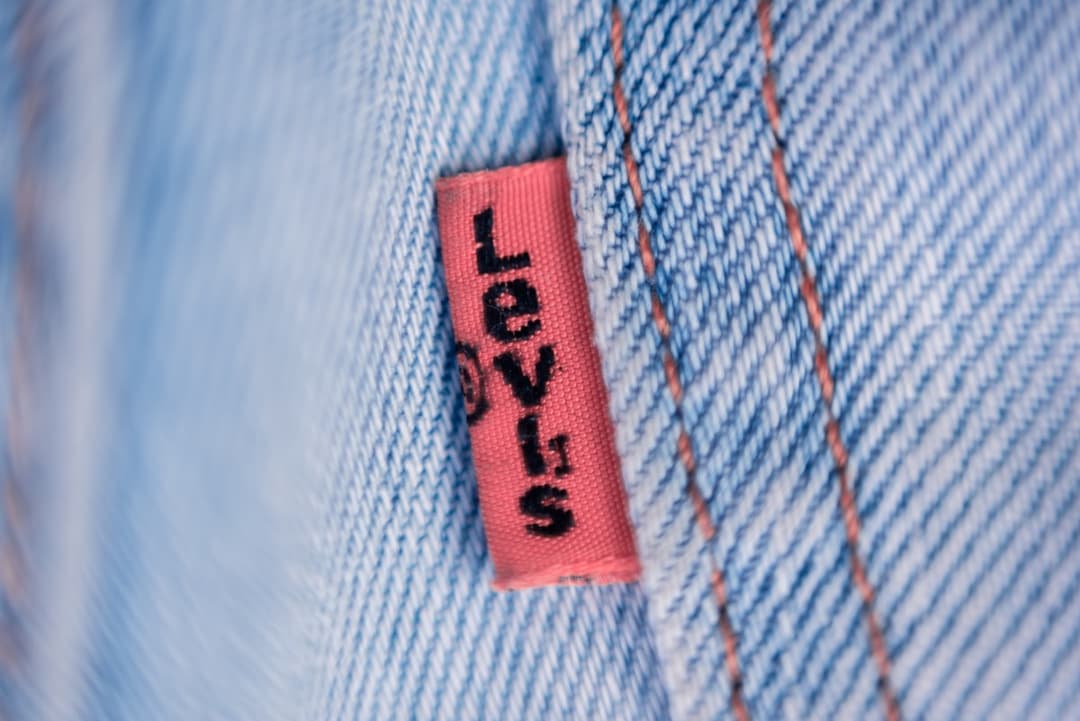
Start at the back right pocket. On a genuine pair, the little red tab isn't applied to the surface of the pocket — it's folded and caught inside the pocket's edge seam, so the fabric of the pocket closes around it. Look at where it emerges. The stitching that holds the seam is the same stitching that holds the tab, continuous and even.
It should sit centered along that edge, at a consistent height, with lettering that's crisp and correctly proportioned. Counterfeiters get close here, but rarely all the way: the tab lands a little high or a little off to one side, the stitches around it bunch or wander, the letterforms are subtly too fat, too narrow, or spaced wrong.
The font is the tell people spot last and trust most. If something about the word looks almost right and you can't say why, believe the feeling and keep checking.
The arcuate should mirror itself
The double arc stitched across each back pocket — the arcuate — is the oldest piece of branding on the garment, and it's harder to fake well than it looks, because it has to be wrong in two places at once to fool you.
Hold the jeans up and compare the left pocket to the right. The curves should mirror each other: same sweep, same depth, same distance from the pocket's top edge, same point where the two arcs meet in the middle. Thread color should match between them, and match the rest of the garment's stitching in weight.
Fakes go astray in predictable ways. The arc flattens out or dips too sharply. The thread is noticeably thicker or thinner than the seams around it, or a shade off in color. Stitch spacing gets loose in the curve where the machine had to turn. One pocket looks fine and its twin doesn't quite agree with it.
Weight in the hand
Now feel the hardware — and feel it, don't just look. Genuine buttons and rivets are substantial. They have a density to them, a small coldness, a solid sound if you tap one against a table. Counterfeit hardware tends to feel light and hollow, thin-walled, faintly tinny.
The top shank button should carry a stamp: "LEVI'S," or the mark appropriate to that era. Then flip the jeans and check the back of the button, the part nobody photographs. Authentic pairs frequently carry a number or factory mark on the reverse, and fakes are inconsistent about it — sometimes blank, sometimes stamped with something garbled.
Do the same with the rivets at the pocket corners. Look at how they're seated: cleanly set, flush, not crooked or crushed into the fabric. Hardware is where counterfeiters cut cost, because it's the only part of the jeans that has to be genuinely manufactured rather than merely printed or sewn.
The two horses, and the question that settles it
Last, the leather patch at the back of the waistband. It should show two horses straining at a pair of jeans, and the detail should be legible — you can make out the harnesses, the legs, the lettering underneath, the edges of the stamp pressed cleanly into the hide. A real patch is embossed with force.
Fakes go blurry here more often than anywhere else. The impression is shallow, the horses turn to mush, the color runs oddly orange or oddly grey compared to the warm tan of the real thing. It's the single most common giveaway we see, probably because it's the detail counterfeiters assume nobody inspects.
And if you're buying online, where you can't press a thumb into a patch or tap a button on a table, all four of these checks come down to one request: can you send me close-ups of the tab, the arcuate, the button back, and the patch? Any honest seller will — we do it every week, no annoyance involved. It's a reasonable thing to ask, and it takes a couple of minutes.
A seller who won't has told you everything you needed to know.